The story so far

Tamara left Bunyip in April 2009 seeking what she needed to know for her permaculture future. She spent 9 months at her Aunt Catherine's farm in Arid South Australia, then 9 months at Bill and Lisa Mollison's farm in Tasmania. Now she's off on more adventures starting Moonrise School of Permaculture and teaching Permaculture Design Courses in the beautiful Dandenong Ranges near Melbourne. Ducky is there for the journey...

Showing posts with label ethical food. Show all posts

Thursday, October 3, 2013

The politics of weeds as a food - and a recipe!


The politics of weeds as a food

Its spring and all the weeds are coming up. Awesome! Time to make some salad!!! I have some theories on herbs and edible weeds. The first is that many of these plants have been part of the human landscape for thousands, even millions of years. It’s no accident that Dandelion, one of the most nutritious plants in the world is found in temperate climates all over the globe. 

It's there because we have been eating it forever, we took it there. Where we call it a weed, it has fallen victim to poison companies and people who have been convinced by Monsanto, Bayer and the like that lawns should be a monoculture, that they should have no food value whatsoever and that we need to poison the hell out of anything other than grass. This is important – if we have food volounteering in our lawns we are less likely to buy vegetable and grain seed and food produced by these same companies.  God forbid we have any say over what we eat, and any food democracy at all.

When we eat a dandelion leaf, we aren’t just getting Vitamin A, B, C, D, fibre, protein, iron, calcium, magnesium, potassium, phosphorus, copper, cobalt, zinc, boron, molybdenum, we are telling multinational corporations to shove their poison and GMO seed where the sun don’t shine.  We are also saying a big up yours to companies like McDonalds who would squash our food independence in the name of money making and deliberate homogenization.

I’m a permaculture designer – one of our principles of design is this:
The problem is the solution.
Where someone else sees a problem and wants to kill it, have a think about how that plant could be utilized. Find out what ecological niche and function it fills and exploit it. Use it for food, or firewood, or basketry, or medicine, or animal forage, or to advance succession.  Once we have figured out how to use it, it is no longer a weed, but an ally. But now, on to the food…

Getting started with eating herbs and weeds can be challenging as many of us haven’t worked with their flavours before. Making a green dressing for your salad, boiled potatoes or meat is a great way to get extra nutrition as well as awesome flavour. I’ve put the ingredients below in ratios to help you make a delicious mix. The trick is to use as many different herbs and weeds as possible, chopped very finely, so that there is no one overpowering flavour. I’ve put down the plants I have tasted and like. There are lots more out there – get researching and foraging! Get your plant ID correct so you don’t get nasty surprises like eating broad leaf plantain instead of narrow leaf plantain – or too much dock - it aint fun, trust me.

And remember – every delicious bite is a political act of independence!


Green Salad Dressing
You can chop any of the ingredients finely and hand mix or use a blender to get a pesto-like consistency with garlic and olive oil.
Add lemon or lime juice to balance the flavour. You can also use good vinegar and a teaspoon of mustard. Then add salt and pepper to taste. Try adding some nuts or capers for extra body.
Be creative and remember to taste as you go and before you season. 

Choose some of these ingredients:

Handful
parsley, broad bean tips, kale, oregano or marjoram, young silverbeet, young rainbow chard, beetroot leaves, basil, coriander, watercress, sprouts, mint, clover leaves, chickweed, mallow, thin leafed plantain (small leaves)

Half handful
sage, thyme, raw sorrel, spring onions, chives or garlic chives, rosemary, chervil, tarragon, borage, lemon balm, nasturtium leaves, mustard leaves, dill, fennel, young dandelion leaves (before flowering), violet leaves, catsear, small fat hen leaves,  purslane, onion weed (allium triquetrum)

Handful blanched
warrigal greens, spinach, silverbeet leaves, nettle leaves and stems, sorrel, amaranth, large fat hen leaves, blanched canna lily (new shoots peeled to green centre)

Pull apart
edible flowers for garnish, Dandelion, Borage, Nasturtium, Calendula, Bergamot, Clover, Rocket, Allium, Pineapple sage, any Brassica flowers

Other weeds I've eaten:

Prickly pear - use caution when harvesting... TRUST ME!!!

Tuesday, July 10, 2012

Sunday Permaculture Breakfasts in Upwey


The sunday permaculture breakfast in Upwey has been going for over a year now and has gathered a pace all its own. People come and go throughout the day - I get home around 3pm (with a sore throat from talking all day) but most people come between 9.30 and 11.30.

If you walk into Magpie Cafe in Upwey at 10.30 on a sunday, the place will be packed, you will be warmly greeted and found a place at the sprawling permie table. Many great friendships have been forged over coffee and free range eggs, and Ducky looks forward to seeing his special adult and children friends as much as they look forward to seeing him.

So how did we start it? Last year some of the Upwey permaculture and Transition Town people took the train to the Lantern Parade in Belgrave and had dinner afterwards. We enjoyed each other's company so much we decided to meet for breakfast the next day. We never thought it would become such an important part of our lives or lead to the formation of the Ultra Local Upwey Permaculture Group, permablitzes and PDCs. 

Here are some ideas for starting your own permaculture breakfast:

1. Choose a local cafe that shares your permaculture ethics - care of the earth, care of people, share the surplus, Magpie Cafe in Upwey has mainly organic ingredients, makes most things from scratch and uses free range eggs and bacon and good coffee and is where most of us ate or drank already. Members of its staff were studying permaculture and are deeply concerned with community. Use the same cafe every week.
Note: A public place is a good idea - it means that no one has to keep their house tidy for guests and it is always at the same place even when people are away. It is also easier to invite people along to a cafe rather than someone's house. 

2. At least one person needs to be at the cafe until numbers start to increase. This means the commitment of one or two people to carry the weekly event. There were several weeks when the weekly breakfast was myself and one other wonderful woman, Michelle Jones, and sometimes it was only one of us. We had a mascot for the table (a chook) and anyone who walked in looking a bit scruffy were asked if they were here for the Permie Breakfast. After a month or two there were three or four people who came every week and the commitment became friendship. This time might be shorter if you already have a permaculture group in your area.

3. We set a time frame of one hour - 9.30 to 10.30. One of us was always there during these times.

4. Have two or three contact people, sometimes we are busy or even out of the country!!! Share the load. 

5. We let people know with a poster on the pinboard in the cafe and in other places in Upwey. The breakfast now grows mainly through word of mouth. Whenever we meet awesome people we'd like to get to know better we just invite them to breakfast :) We have also had our events up on facebook and we now have a page for the local group. Add people to an email list and send them out info.

6. We meet weekly. Friendships are formed much faster with weekly contact, even a very short hello once a week will create connections faster than a monthly meeting (I do support monthly meetings, they are fantastic too). This is all about creating a human ecology of regularly maintained connections.

7. Tell the cafe what you're doing - they will hopefully like the idea, and be able to staff for it when it becomes larger, but more importantly they will tell people about the breakfast.

8. Have fun. This is a social day with no commitments whatsoever. Make it clear to people you invite that it is just breakfast. No one needs to join a committee or is roped into work. This is a commitment free permaculture breakfast. People can come as often as they like. Some people will come weekly and some will come monthly, some will come once or twice a year. Tell people this is okay. There is no need to commit to regular breakfasts - they are just a place to come and meet like minded people and then go home again feeling happier for the contact.

9. If you want to grow your group or breakfast or community quickly, run some free courses. Run a free introduction to permaculture or two full Permaculture Design Certificates (PDCs) like we did. Its a fast way to increase the number of permies in the area and start effecting real change.

10. Have an animal mascot. If your cafe has an outdoor area, have a favourite chook or duck that people and children will want to see. It helps other people in the cafe get to know about permaculture too. Ducky comes every week and there are people that come just to see him.
Ducky is the star attraction at Upwey sunday permaculture breakfasts
11. Be prepared for the friendships you will form. You may never feel alone or different in the world again. The breakfasts have become an essential part of my weekly routine, my life and my sanity. The people in our group have been tremendously supporting to each other. We have started many community projects just by chatting over coffee. These friends have helped me start teaching PDCs, I know that without them it would not have happened. So thank you Upwey permies, I LOVE YOU!!!

Good luck everyone!!! These are just my points, other people in the group will probably have more to share - its been an amazing group effort!!! Send us any ideas or comments you have - or how you go with your own breakfast!!! 

Love Tamara and Ducky xxx qqq

Wednesday, November 9, 2011

PPP Blog day 2

PPP Day 2 blog

Blogging this morning begins with the yellow tail black cockatoos calling and waiting for the breakfast coffee to come out…

Day two started with Geoff, Nadia, Tim and the interns killing an 8 month old calf. I didn’t attend, I’ve seen sheep killed and I always cry. That was in 2007 in Tassie when Geoff and Nadia did a practical fortnight down at Bill and Lisa Mollison’s farm in Tassie. I felt embarrassed that I was crying, as no one else was, but geoff and bill both pulled me aside privately and told me that whenever indigenous people kill an animal they shed a tear of reverence for its life. That made me feel better.  The interns felt much the same as me – that if we eat meat we have a responsibility to know where that meat comes from and to know that it has had an ethical life and the best death we can give it. It was in stark contrast to what was exposed on the Four Corners program earlier this year – where cattle exported to Indonesia watched while the cow in front of them was slaughtered, without stunning before their throats were cut and other horrific violence. The Live Export trade ceased briefly due to the public outcry but it was resumed with new rules that are designed to supposedly protect the cattle from this. I don’t think it goes far enough and want live export banned – something I continue to work on.

Ethical treatment of animals is one of the reasons I practice and teach permaculture. A chicken deserves to be used for its natural labour – scratching, poo-ing, collecting bugs and basically doing the work of the gardener in a chicken tractor vegie bed system. Ethical eggs and potentially ethical meat is better than a short life in battery cages or a barn full of chickens with no access even to sunlight outside.

So – there are things I am against – but permaculture is about positive action – and so I act in a positive way to stop the cruelty of the factory farming of animals of unthinking consumption. 

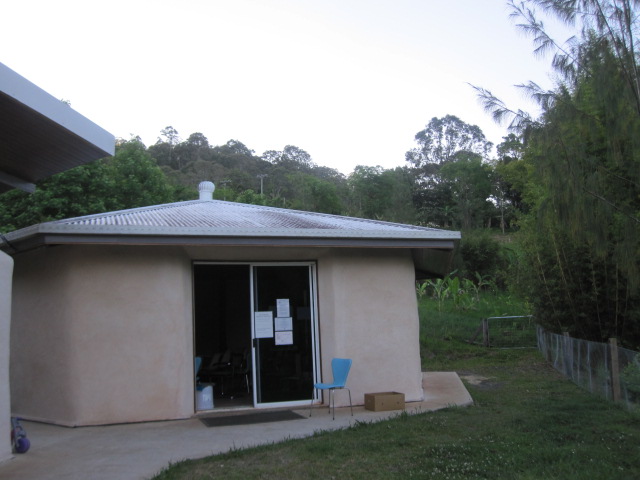
The Hex - our classroom, made of strawbale and designed for the sub tropics!

Ok, on to the classes! Geoff took us through teaching techniques in the morning – beginning at the end of the PDC with the final night party – where students do a performance for their classmates. It is a raucous occasion, I’ve been to one and I love it. It is an emotional and transformational night but demonstrates that we can still be self sufficient in fun.

Hooray!! Coffee has just arrived!!!!! With pikelets – Yummy. Blog will be getting better directly!

Geoff has “must touch points” on each topic over a 90 minute lecture. He tells 2 stories, 2 analogies, 2 laughs and 2 almost tears moments. He also ran us through some blackboard diagram and timing techniques – and developing a repotoire of symbols for explaining concepts and designs. He reminded us of mapping and sunside depending which hemisphere we are in, and drawing contours and plans. He explained an interactive game he used to do with students using a zone map, plasticine animals and building a design.  

Then! We found out we had to do a 3 minute presentation from one of the chapters in the Designers Manual. I am pretty good at thinking on my feet but I chose a familiar topic – arid strategies - using my childhood home as an example of sites. I went ok, but I had a big pause in the middle – but picked it up again. People did much better at their presentations than yesterday, I had improved too, getting more eye contact in. In the evening we looked over the film with our classmates again. I have to say I felt very supported after what I had considered a bomb! They liked the hook of my stories but would have preferred just one topic in the 3 minutes. This morning Geoff said I was ok, but wanted me to round out the topic more – rather than being site specific. We have a 5 minute presentation today and I'm hoping to make some improvements using the comments from every one.